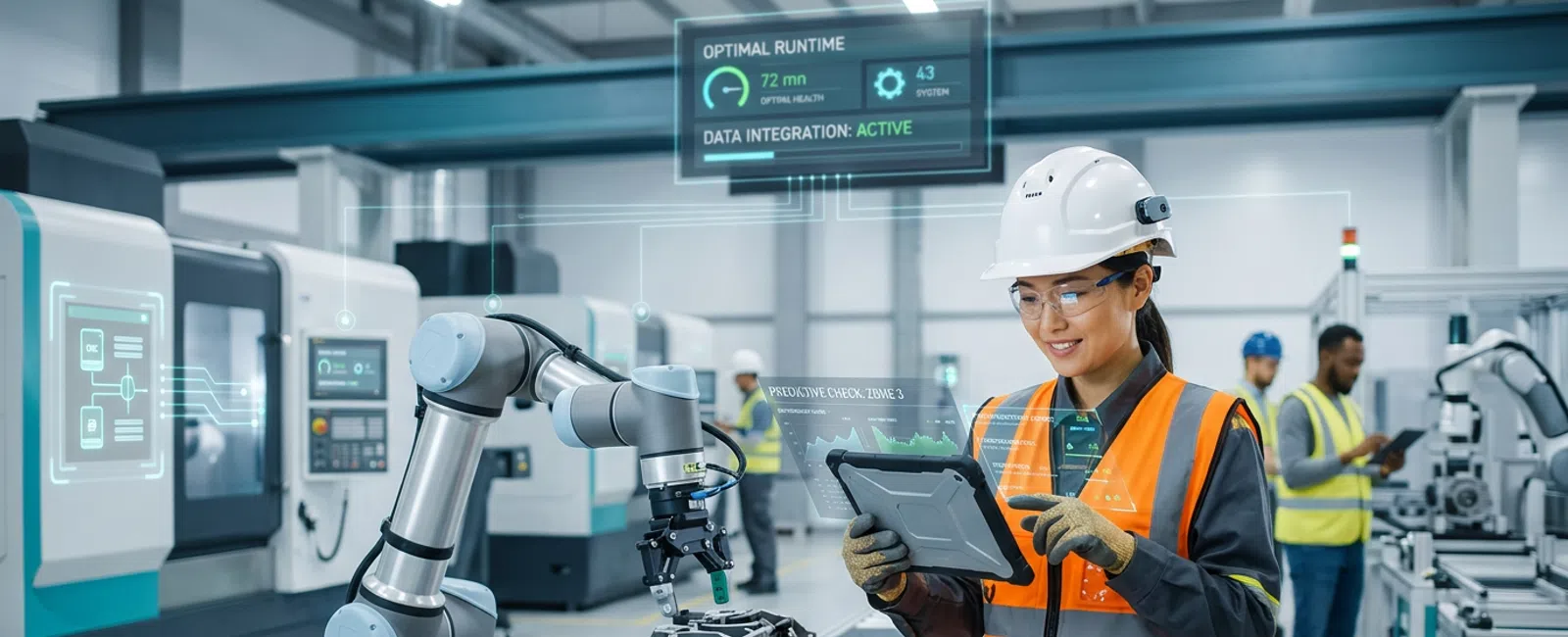
How AI Supports Manufacturing Operations Without
Replacing Teams
Discussion of artificial intelligence in manufacturing often
centers on workforce displacement. Operational data points in a different
direction. The applications delivering measurable returns today largely support
existing employees rather than substitute for them.
Predictive maintenance illustrates the pattern. IoT
Analytics research found that 95 percent of organizations implementing
predictive maintenance report positive return on investment. McKinsey documents
maintenance cost reductions of 18 to 25 percent and downtime reductions of 30
to 50 percent. These systems do not perform repairs. They tell maintenance
technicians where to look and when, converting reactive emergency work into
scheduled tasks.
Computer vision quality inspection follows similar logic. Current systems reach 98 to 99 percent accuracy on defined defect classes with reported returns of 200 to 300 percent. Inspectors shift from repetitive visual checks toward root cause analysis and process correction, work that requires judgment machines do not supply.
The workforce context matters. CustomerTimes 2025 data
estimates 2.5 million manufacturing workers will retire by 2027. That departure
removes decades of troubleshooting knowledge from production floors. AI
supported documentation, searchable procedure libraries, and guided diagnostics
help capture that expertise before it leaves.
Adoption is broad but uneven in results. PwC's CEO survey
found 56 percent of chief executives report neither revenue gains nor cost
savings from AI investment, with only 12 percent achieving both. The gap
generally traces to implementation rather than technology. Projects that begin
with a defined operational problem outperform projects that begin with a tool.
Training data reinforces this. Training Magazine's 2025 Industry Report found 37 percent of organizations now use AI in training, up from 25 percent in 2024. Organizations that train employees on AI tools see 93 percent active usage compared with 57 percent when access is granted without instruction. Notably, 84 percent of employees believe AI training should begin during onboarding.
One of our longtime clients recently promoted three members of its customer support team into full-time inside sales roles. The change came from a single targeted implementation. The company had been relying on as many as five support staff to manually translate customer order numbers into its own internal part numbers before any order could be processed. It was slow, repetitive work, and it was prone to errors.
The client deployed a third-party AI module that maps customer orders to internal part numbers automatically. Orders are now converted, validated and entered into the order system with little to no manual input. That freed up the equivalent of three full-time employees at the same time the inside sales team needed more people.
Rather than cutting those positions, the company moved those employees into sales. They already knew the products, the customers and the business, so they got up to speed far faster than new hires could have. In my experience, this is what well-applied AI looks like. It doesn't eliminate people. It moves experienced people into higher-value work the business already needs done.
Infrastructure readiness is the common prerequisite. AI
applications depend on reliable data collection, adequate bandwidth, consistent
connectivity, and integration with existing systems. Facilities with unreliable
networks or inconsistent machine data typically cannot support these tools
regardless of software quality.
For leadership evaluating opportunities, proven applications
offer better starting points than experimental ones. Predictive maintenance,
quality inspection, demand forecasting, and documentation support all have
established track records and mature vendor ecosystems.
The framing that matters is capability, not replacement.
Manufacturers facing skilled labor shortages and retirement waves need tools
that make available workers more effective. That is where current returns are
concentrated.
Practical Next Steps
Manufacturers evaluating artificial intelligence get better
outcomes by starting with an operational problem rather than a technology
selection.
Pick one measurable pain point. Recurring equipment
failures, inspection bottlenecks, or knowledge loss from retiring staff all
have proven tool categories behind them.
Verify infrastructure readiness before committing. Reliable
machine data, adequate bandwidth, consistent connectivity, and integration
paths determine whether any tool performs as promised.
Plan for adoption, not just deployment. The gap between 93
percent usage with training and 57 percent without it is a management outcome,
not a software feature.
Define what success looks like in advance. Hours recovered,
defects caught, or downtime avoided give leadership a basis for deciding
whether to expand or redirect the investment.