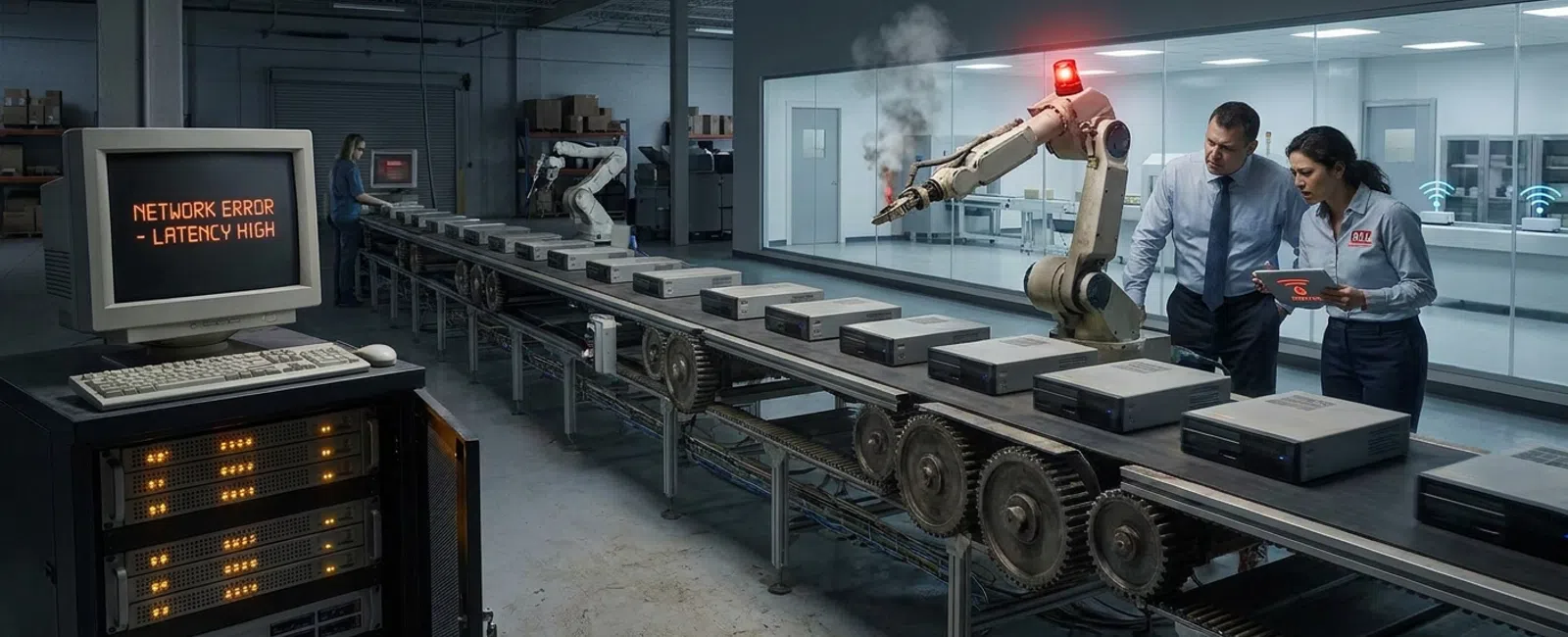
Why Outdated IT Networks Create Production Bottlenecks
Manufacturers often discover that their production
constraints are not mechanical. They are digital. As plants add sensors,
machine monitoring, quality systems, and cloud based ERP connections, network
infrastructure designed a decade ago struggles to carry the load.
Siemens' 2024 True Cost of Downtime report found that
unplanned downtime costs the world's 500 largest manufacturers roughly $1.4
trillion each year, about 11 percent of revenue. That figure rose 62 percent
from 2019. Aberdeen Group research places average manufacturing downtime at
approximately $260,000 per hour, while small and mid sized plants typically
report near $150,000 per hour.
Network age is a measurable contributor. Many facilities still run switches and access points that predate current bandwidth demands. When a single line adds machine vision cameras or wireless scanners, latency rises, dropped packets increase, and operators lose confidence in the data. Teams then revert to paper workarounds, which erases the visibility the technology was purchased to provide.
Aging Network Discovery
One
manufacturer we worked with had a mix of old and new throughout its plant. Some
of its machines were more than 30 years old and still ran well. The IT gear was
close to 10 years old, but it wasn't aging nearly as well.
The company
had also grown. Its production floor was more than 40% larger, and network gear
and cabling had been added along the way. They were running several shifts, six
days a week, on a network that was built for a much smaller plant.
We were
brought in to assess the IT setup and find out where it was holding the
business back.
We looked
at the network, cabling, Wi-Fi, plant layout, and how people used the systems
each day. Large steel machines and storage racks made Wi-Fi a challenge. We
also looked at the security needs coming from their customers.
Instead of
replacing everything at once, we built a plan they could roll out over 18
months without getting in the way of production.
Once the
work was done, staff had much better Wi-Fi on the plant floor and could make
better use of laptops where the work took place. Production data that had taken
two or three days to reach the right people was now available in real time.
They were also in much better shape when customer security forms landed on their desks, with far less work needed to meet the requests.
Two infrastructure gaps appear repeatedly across
manufacturing environments.
- Flat
networks. Office traffic, guest Wi-Fi, and production systems
share the same segment, so one congested application can slow the plant
floor.
- Single
path connectivity. A single uplink or single internet circuit
means one hardware failure stops shipping, scheduling, and quality
reporting simultaneously.
Wireless coverage presents a separate challenge. Metal
racking, moving equipment, and high ceilings create dead zones that were
tolerable when Wi-Fi supported email but are disruptive when it supports
scanners and tablets tied to inventory accuracy.
Cockroach Labs' State of Resilience 2025 report found
average outage duration of 196 minutes across industries, with only 2 percent
of organizations resolving unplanned outages in under a minute. Two thirds of
companies experience downtime at least monthly. For a plant running at $150,000
per hour, a single three hour event approaches $450,000 in exposure.
Measured Improvement After Remediation
A packaging manufacturer brought us in to help upgrade its ERP system. During
the planning, we met with staff to learn what was slowing them down.
The
issue went beyond the ERP software. Production orders and shipping tasks were
still handled in batches and required a lot of hands on work. Staff also had
limited access to the system in parts of the plant and shipping area.
We
recommended upgrading the network and Wi-Fi along with the ERP so the company
could get more from the new system.
Once
the work was done, production data could be updated in real time. That helped
staff plan work and process orders faster. Better Wi-Fi also allowed the
company to add workstations on the production floor and throughout the shipping
area. Staff could enter and check information where the work was being done,
which helped cut errors and speed up shipments.
The
gains also freed up staff. Two employees who had worked in the production
office were moved into customer service because much of the manual reporting
work was no longer needed.
There
was another benefit behind the scenes. Backups that had struggled to finish on
time could now run within the nightly window. Instead of getting one complete
backup a week, the company had a complete backup each day.
The practical takeaway for leadership is that network
infrastructure should be evaluated on the same schedule as production
equipment. Most manufacturers have documented preventive maintenance intervals
for machinery and no equivalent lifecycle plan for switches, firewalls,
cabling, or wireless controllers.
Several questions help establish current position. When was
the last documented network assessment? Are production and business systems
segmented? Does any single device failure halt operations? Is wireless coverage
verified through survey data rather than assumption?
Deloitte research indicates 56 percent of manufacturing IT
spending goes toward maintenance rather than improvement. Facilities that plan
infrastructure refreshes deliberately tend to move that ratio, freeing budget
for capability rather than repair.
Where to Start
Network infrastructure rarely fails all at once. It degrades
quietly until operators stop trusting the data and revert to workarounds.
Manufacturers who want to get ahead of that pattern can begin with three
concrete steps.
Document what exists. An accurate inventory of switches,
access points, firewalls, cabling, and circuit paths establishes a baseline
that most facilities currently lack.
Identify single points of failure. Trace what stops if any
one device or circuit goes down, then prioritize the paths that touch shipping,
scheduling, and quality reporting.
Put infrastructure on a lifecycle schedule. Production
equipment has documented replacement intervals. Network hardware should carry
the same discipline, reviewed annually alongside capital planning rather than
replaced only after failure.